
Don’t have time to read this? Listen to the Podcast on: Apple Podcasts | Spotify | Others
Introducing a New Series of Articles & Podcasts
I’m currently in the process of writing a book called The Past and Future of the Gospel Rescue Mission Movement. The first half of this book will look at the history of the first four waves of the Rescue/City Mission movement over the last 200 years. The second half will focus on the outline of an emerging Fifth Wave of the movement. I hope to release this book later this year. If you would like to be a “beta reader” to provide feedback before publication, please respond in the comments below.
This article starts a new season and series of articles that will highlight some of the “greatest hits” of external resources I’m using in my research to develop this book. The focus of this article is H. Richard Niebuhr’s seminal 1929 book, The Social Sources of Denominationalism. This article provides a summary of that book, which has remarkably timely lessons for Rescue Missions even though it has been almost 100 years since the book was published. While Niebuhr is best known for his book Christ and Culture, The Social Sources of Denominationalism is extremely relevant to rescue missions today.
The Gravitational Pull of Secularization
Harvard University’s original founding motto was Truth for Christ and the Church, and it actually carried the mandate that every single student know God. The YMCA was founded exclusively for the spiritual needs of young men in industrialized London. But today, both of those massive, globally recognized institutions have become some of the most notable case studies of mission drift and secularization. They traded their explicitly Christ-centered mandates for a generalized secular humanitarianism.
The question is, how did that happen? And more importantly, if you’re running a faith-based organization today, is your rescue mission next?
It is a terrifying historical reality for any ministry leader to confront. We’re talking about a gravitational pull toward secularization that seems almost unavoidable if you don’t know exactly what to look for. To help leaders of gospel rescue missions, city missions, or any faith-based nonprofits understand these existential threats, we are layering two profound sources on top of each other. We are starting with a truly foundational, almost prophetic sociological text: H. Richard Niebuhr’s seminal 1929 book, The Social Sources of Denominationalism. The second source is excerpts from The Past and Future of the Gospel Rescue Mission Movement. Niebuhr provides a deep sociological critique of how Christian institutions naturally evolve and compromise based on social class, and we will apply that framework directly to the massive challenges facing modern gospel rescue missions today.
Niebuhr’s Sociological Critique: The Human Caste System
Niebuhr’s core thesis, written almost a century ago, stings a bit. He calls the denominationalism within the Christian church an “unacknowledged hypocrisy.” He argues that the divisions we see in the church—Baptists, Methodists, Presbyterians, Episcopalians—aren’t actually theological in their origin. He says they represent the accommodation of Christianity to the human caste system.
The gospel explicitly condemns divisiveness and seeding the rich and the poor apart. Yet, the profound social and economic inequalities in our society end up dictating the actual boundaries of our religious groups anyway. People do care deeply about theology, and Niebuhr isn’t suggesting that theological debates are fabricated cover stories for class warfare or that individuals don’t genuinely believe them. However, his sociological analysis suggests that human beings have a universal tendency to find highly respectable intellectual reasons for practices that are actually born out of basic social and economic conditions.
Think of it like sports rivalries. A fan might passionately argue they despise a rival baseball team because of their management philosophy or lack of fundamental fielding. But at the end of the day, the real reason they hate that team is simply because they live in a neighboring rival city. The geographic reality created the tension; the arguments over playing style are just post-hoc rationalizations to make the hatred feel objective. Niebuhr argues that geography and social location largely dictated the theology.
Niebuhr illustrates this dynamic by looking at the Pharisees and the Sadducees in ancient Judea. While we often learn about them as groups having purely doctrinal disputes (like the Sadducees denying the resurrection and angels), Niebuhr points out that the Sadducees were the wealthy, Hellenistic aristocracy. They were the political elite who collaborated with Roman authority to maintain their upper-class status. The Pharisees, conversely, were more grassroots. They were closer to the common people and deeply invested in maintaining distinct cultural purity against imperial assimilation. Their theological differences sprouted from profound social, economic, and political divergences.
If you are the CEO or a board member of a gospel rescue mission today, Niebuhr’s critique forces an uncomfortable audit. You can have the most orthodox, biblically sound statement of faith beautifully framed in your lobby. But you have to look at the demographics of power. Who is sitting in your boardrooms making financial decisions, and who is sleeping in your shelters? If your mission is entirely bifurcated along economic lines—wealthy professionals in leadership and the impoverished marginalized in the programs—Niebuhr would argue you are actively participating in that unacknowledged hypocrisy.
The Cycle of the Disinherited
Niebuhr maps out a highly predictable life cycle for religious institutions that moves from the disinherited all the way to the middle class. It begins with the established churches becoming captured by the cultured, wealthy, and politically powerful elite. When the elite take over, the theology grows highly abstract and intellectual, rituals become formal and polished, and ethics become harmlessly compliant with the ruling class (what Niebuhr calls the “morality of respectability”).
For the working class, the poor, and the uneducated, this established faith no longer meets their intense psychological needs, nor does it offer an ethical ideal that speaks to their suffering. They find themselves religiously frozen out. Because nature abhors a vacuum, this alienation sparks a spontaneous grassroots revolt. The lower socioeconomic strata create what Niebuhr famously coined the “churches of the disinherited.”
These rebel groups operate differently. They are lay-driven, led by charismatic individuals from within their own ranks rather than educated professional clergy. Worship is highly emotional, focusing on a visceral, transformative religious experience. They emphasize mutual aid, fierce equality, radical critiques of societal wealth, and often lean heavily into apocalyptic hopes. When you are at the absolute bottom of the social hierarchy, you want a theology that promises a divine reversal, where the last shall be first.
But there is a profound irony to their success. As these new sects form, they enforce worldly asceticism. They demand industry, sobriety, frugality, and the abandonment of expensive vices. Pragmatically, when marginalized people adopt these behaviors, their material conditions rapidly improve. John Wesley watched this happen to his Methodist movement in real time, noting: “Religion necessarily produces industry and frugality, which cannot but produce riches, thereby causing the essence of religion to decrease in the same proportion.”
As the first generation of marginalized converts gives way to a second and third generation born into financial security, the sect transitions into a church of the middle class. Apocalyptic hopes die out because they are now doing well in the current world order. The passionate lay evangelists are replaced by professional clergy. Movements like the Anabaptists, Quakers, and Methodists all started as raw, disinherited movements and eventually gentrified into middle-class denominations. When they gentrify, they abandon the urban poor, creating a new vacuum, and the cycle starts all over again.
Geography and Theology: The Frontier and Slavery
Economics interact with physical geography in fascinating ways. Looking at the American frontier, Niebuhr argues that the sheer geography of the advancing West created its own distinct religion. The brutal realities of frontier life—extreme isolation and the exhausting struggle for physical survival—stripped away formal education and the polished inhibitions of settled urban society. It birthed the emotional intensity of the camp meeting and revivalism.
This geographic reality manifested in the theological battle between Calvinism and Arminianism. Calvinism, with its core doctrines of predestination and divine order, fit perfectly with the established, settled, mercantile East. But Arminianism, which emphasizes free will, individual choice, and intense human effort, perfectly suited the self-reliant, individualistic frontier West.
Niebuhr also analyzes the painful North-South split over slavery. The differing theological attitudes evolved directly from broader economic forces. The rapidly industrializing North did not rely on enslaved labor, while the agrarian South was entirely built on it. When Northern churches embraced abolitionism, the Southern churches achieved a fierce sectional solidarity to defend their economic system. They formulated sophisticated moral and biblical rationalizations to idealize slavery, leading denominations to fracture geographically. The underlying economic reality demanded a theological justification to protect the status quo. Today many might argue that the housing crisis is a similar issue except this time the dividing line is across social class (home ownership) rather than race.
The Five Waves of Rescue Missions
Modern gospel rescue missions are the direct institutional descendants of those early churches of the disinherited. When gentrified middle-class churches abandoned the deteriorating inner cities, rescue missions stepped right into the vacuum. The Past and Future of the Gospel Rescue Mission Movement breaks this evolution down into five distinct waves:
The City Mission Society (1815-1870): Sparked by the Industrial Revolution, mass urbanization created immense squalor. The traditional parish church system collapsed under the density, leading to interchurch coordinating bodies aiming to re-Christianize and aid these alienated populations.
The City Mission (1826-1880): Pioneer David Nasmith shifted from utilizing wealthy middle-class volunteers to employing full-time, working-class lay agents who shared the culture, dialect, and life experiences of the impoverished people they served.
The Gospel Rescue Mission (1870-1910): Following the American Civil War and the birth of skid row, figures like Jerry McAuley (a former river thief who found faith in Sing Sing Prison) started missions. The massive innovation here was indigenous leadership by converted outcasts—their own transformed lives provided undeniable proof of the gospel’s efficacy.
Mission Networks (1900-Present): To survive isolation and the deaths of charismatic founders, independent missions formed networks (like the Citygate Network) to share resources and operational best practices.
The Fifth Wave Mission (2010-Present): Modern missions face extreme complexity. They are no longer just handing out soup; they are managing co-occurring severe psychiatric disorders, fentanyl epidemics, and massive real estate development, all within an intensely regulated, post-Christian, secularizing environment.
This creates the defining leadership tension of the fifth wave: The Complexity Principle vs. The Indigenous Principle. The complexity principle dictates that a mission must integrate science, advanced organizational management, clinical psychology, and serious business acumen to survive. Missions often need CPAs and Licensed Professional Counselors as they scale. The indigenous principle demands that missions stay culturally close to the poor, relying on grassroots relational ministry, lived experience, and orthodox theology. The tension is how to become professional enough to handle modern crises without becoming so polished and middle-class that you alienate the very people you were founded to serve. If the complexity principle totally overrides the indigenous principle, the mission gentrifies, loses its soul, and secularizes.
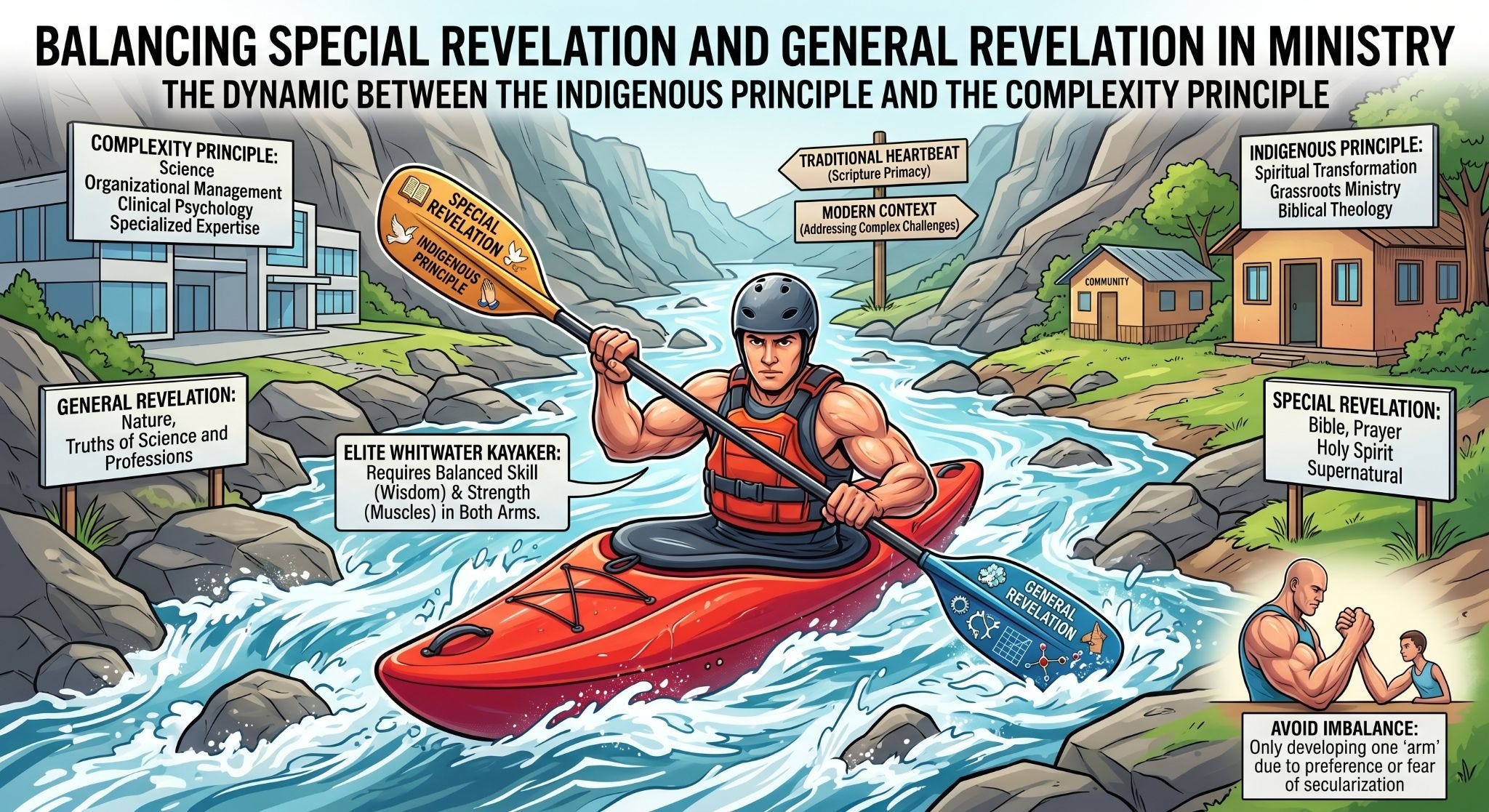
The key is to keep these two principles in balance (as shown in the above image). In real ministry, this balance is more like balancing a boat as it goes down a river, with constant readjustments needed to stay balanced depending on specific decisions in each context. For most rescue missions, the river may seem like going through whitewater rapids.
To maintain this balance like an elite whitewater kayaker is very difficult. It requires having skill (wisdom) and strong muscles in both your right and left arms. Unfortunately, too many Christians I’ve come across overly focus on developing their right (special revelation) or left (general revelation) arms. Some evangelical Christians have become cautious of general revelation through witnessing the history of secularization and the tendency of Christians and ministries to get assimilated because they did not prioritize Scripture enough. This risk of secularization is a major threat to rescue missions and will be discussed in detail in the full book, The Past and Future of the Gospel Rescue Mission Movement.
A more common reason many individuals have a preference for their right (special revelation) or left (general revelation) based on upbringing, their personality/gifting and communities of which they are a part. These individuals then invest all of their development into special revelation (theology and Scripture) or general revelation (science and the professions). This could be compared to Matthias Schlitte, a German arm wrestler born with his right arm significantly larger than his left, so he focused his training on his right arm. This made him famous for viral photos of his freakishly large right arm in contrast to his left arm.
But this type of imbalance is no way to live our lives or run our ministries. Unfortunately, this type of imbalance is all too common. One reason is that like attracts like: we develop into tribes of people who agree that we should only develop our right or left arms.
The Mechanics of Mission Drift
One useful sociological tool to better understand drivers of mission drift is Resource Dependence Theory (RDT). RDT posits that an organization’s survival is contingent upon its ability to acquire resources. As modern missions need tens of millions of dollars, they become highly vulnerable to external actors like government agencies.
A historical example of this is the “pinch of incense to Caesar.” This refers to in the early Roman Empire, when authorities demanded that Christians drop a small amount of incense onto an altar dedicated to the emperor as a mandatory test of civic loyalty to avoid persecution. It starts as a pragmatic compromise—accepting a government grant to keep a shelter open. But the state attaches stipulations. First, they might dictate that you cannot require chapel attendance. Then, a hiring practice is restricted. Eventually, you must adopt secular clinical metrics to prove success. Over a few decades, you quietly sideline your evangelistic core.
This is supercharged by Institutional Isomorphism, which explains why organizations eventually look exactly like one another. This comes in three kinds:
Coercive Isomorphism: Forced compliance, like a city zoning board withholding permits unless you adopt their exact secular anti-discrimination bylaws.
Mimetic Isomorphism: When facing uncertainty, missions blindly copy the operational handbooks of heavily funded secular agencies, unintentionally importing their underlying secular philosophy.
Normative Isomorphism: Driven by a need for professionalization, missions hire staff from secular academic universities. Over time, an HR director might replace theological vocabulary like “sin” and “redemption” with “maladaptive behaviors” and “systemic barriers,” fundamentally rewriting the culture.
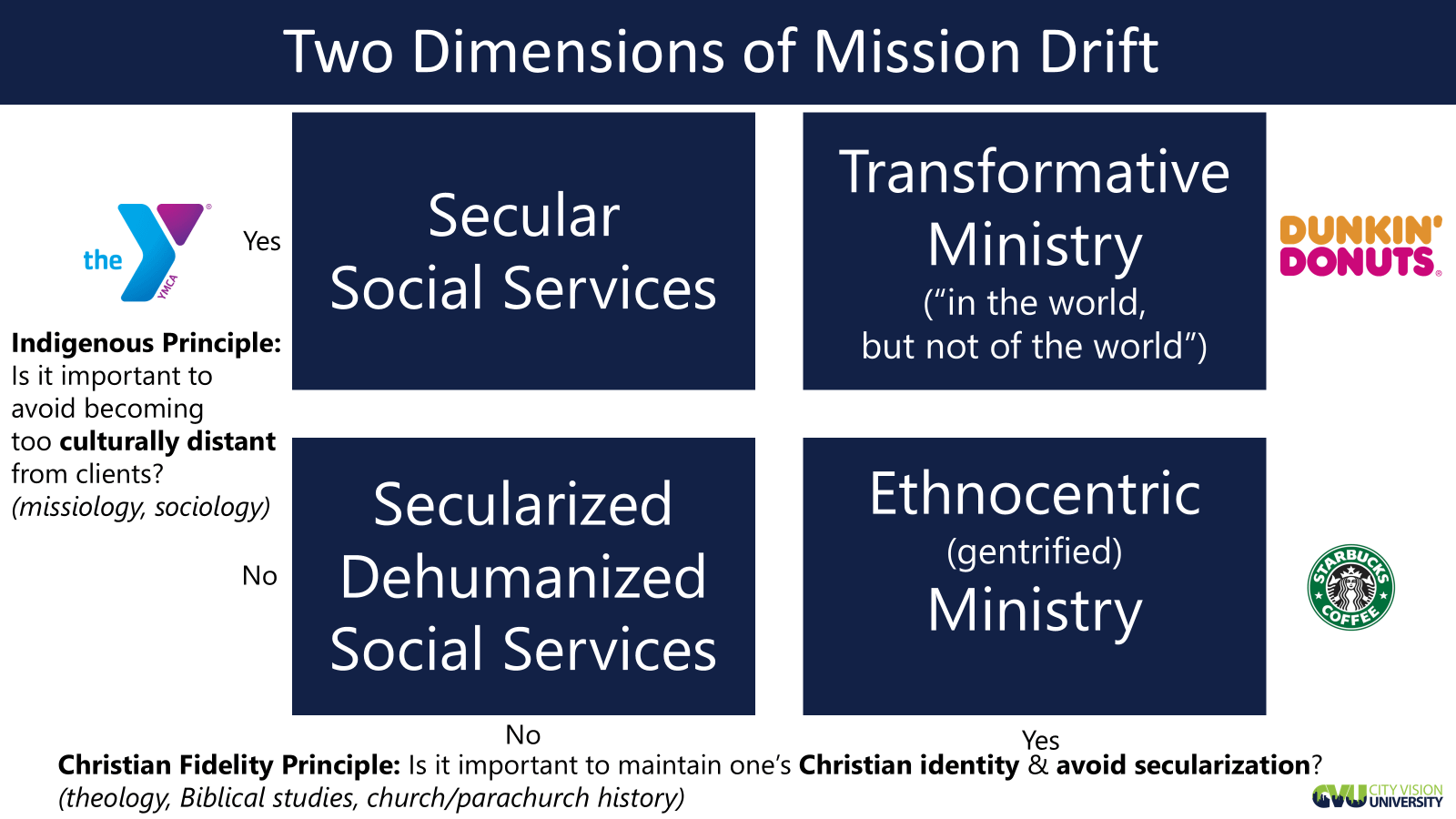
This drift is often finalized by the “successor syndrome,” where a retiring founder is replaced by a highly competent CEO who lacks deep theological alignment, accelerating the mission’s secularization.
Dr. Sears visualizes this drift through four cultural quadrants:
Quadrant 1: Total Drift. Low theological and cultural fidelity. A secularized, hyper-bureaucratic office.
Quadrant 2: Secular Social Services (The YMCA Model). Low theological fidelity, high cultural fidelity. Serving the right demographic but having lost their spiritual core.
Quadrant 3: Cultural Drift (The Starbucks Model). High theological fidelity, low cultural fidelity. The theology is orthodox, but the institution gentrifies. It becomes polished, corporate, and deeply alienating to the working-class origins of the movement.
Quadrant 4: Mission True (The Dunkin’ Donuts Model). High theological and cultural fidelity. The mission integrates professional excellence while fiercely protecting its orthodox roots and grassroots, approachable culture. Excellent, but highly accessible.
The Post-Christian Legal Battlefield
Historically, rescue missions operated with the implicit backing of a dominant Western culture. Today, we are in a “negative world,” as Aaron Renn calls it, where orthodox Christian theology is increasingly viewed by the broader secular culture as harmful. This hostility translates directly into employment law—the “hiring line in the sand.”
Because personnel is policy, an organization’s theological identity is ultimately determined by the people it employs. If a mission is legally prohibited from utilizing religious criteria in its hiring, this can become a form of forced assimilation.
In Canada and Europe, missions are largely unable to use religious criteria in hiring except for somewhat narrowly defined ministerial positions. There is currently a battle playing out in courts over whether ministries will retain this right. However, because of the protections for religious freedom in the United States, it seems likely that this freedom will continue to be protected as it has throughout US history. The most recently related court cases of rescue missions include:
Woods v. Seattle’s Union Gospel Mission (2022): In Woods, an applicant sued after being turned down for a legal clinic position due to his same-sex relationship, resulting in a Washington Supreme Court ruling that limited state religious employment exemptions strictly to “ministerial” roles.
Union Gospel Mission of Yakima v. Brown (2026): Prompted by Washington state’s legal shifts, the Yakima mission preemptively sued state officials to defend faith-based hiring across all staff positions, winning an initial Ninth Circuit appeal before the full circuit court voted to rehear the case en banc.
Wyoming Rescue Mission v. EEOC (2022): Conversely, the Wyoming Rescue Mission successfully sued state and federal agencies, securing a favorable settlement that protected its First Amendment right to require Christian faith commitments for thrift store associates who support its religious recovery programs.
By contrast, in some parts of the world, when City Missions made the choice to accept an overwhelming percentage of government funding decades ago, they were legally forced to abandon their Christian hiring requirements. Today, they operate as highly effective, structurally sound, yet thoroughly secularized subcontractors of the state.
The Center Church Framework & Strategic Solutions
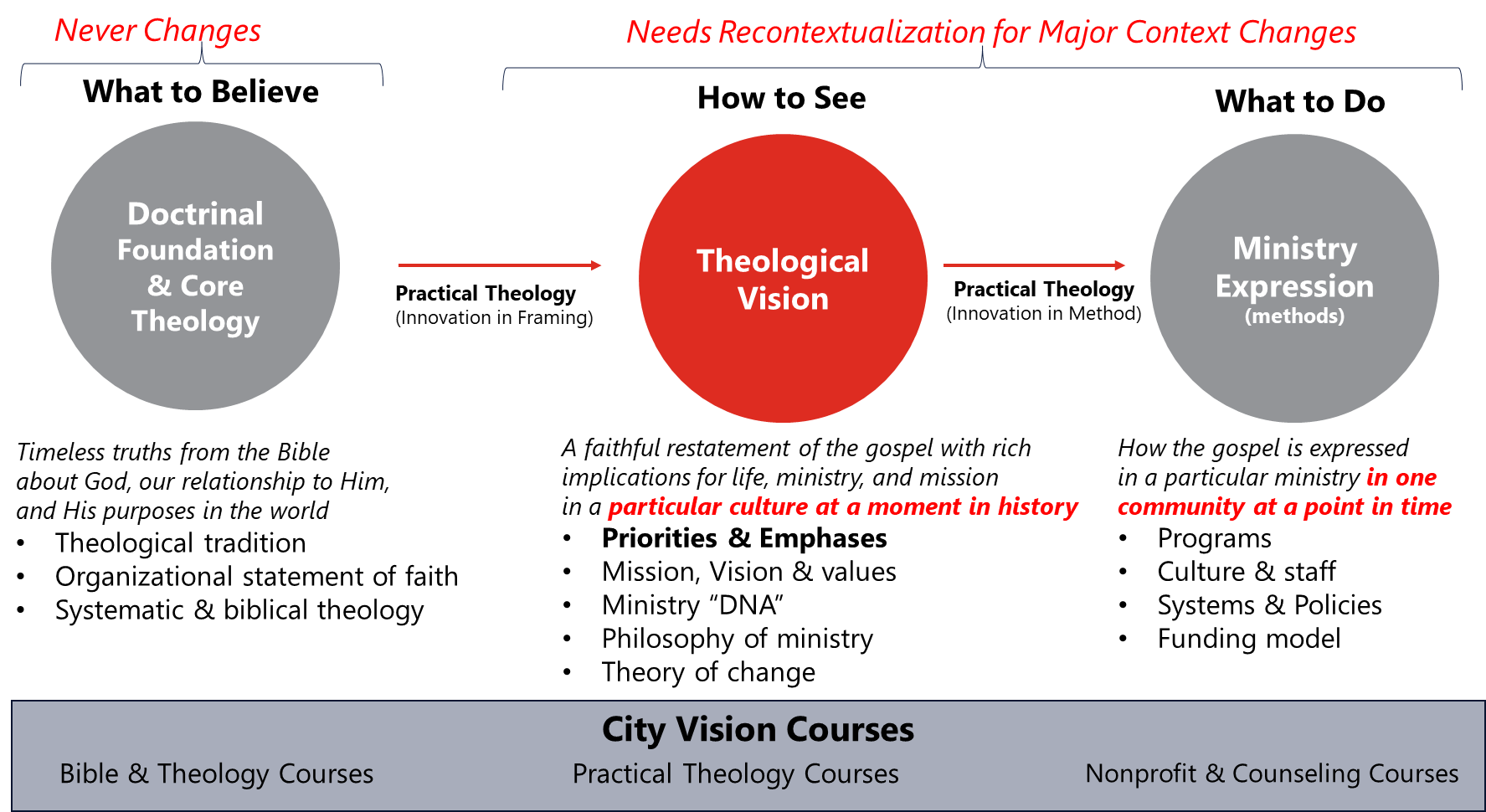
To survive without accidentally altering their core identity, missions can adapt Tim Keller’s “Center Church Framework”:
Doctrinal Foundation: The immovable anchor of timeless biblical truths (e.g., the necessity of repentance, the authority of scripture, the Imago Dei).
Theological Vision: The cultural translation layer. How the unchanging foundation applies to a specific city facing a specific crisis (like integrating trauma-informed care without losing sight of spiritual redemption).
Ministry Expression: The boots on the ground—employee handbooks, clinical modalities, physical architecture, and marketing.
Drift happens when there is a disconnect between the doctrinal foundation (espoused values) and the ministry expression (enacted values). If a shelter floor relies exclusively on secular therapies without spiritual integration, the practical ministry will inevitably pull the doctrinal foundation downstream.
There are three strategies to avoid the tendency toward secularization:
Mastering Complexity: Missions must aggressively embrace professional excellence. They should utilize regional alliances to consolidate back-office operations and integrate tools like Christian Cognitive Behavioral Therapy (CCBT), which marries effective clinical techniques with orthodox theological goals. They must also invest heavily in advanced data architecture to empirically prove the efficacy of their spiritually integrated programs to a secular world.
Enforcing Christian Fidelity: Missions must legally fortify their right to hire co-religionists, utilizing legal advocacy groups to audit employment documents. They must strategically balance their board of directors, pairing wealthy corporate executives with orthodox pastors and program alumni to prevent gentrification. Crucially, they must prioritize rigorous staff catechesis, explicitly teaching secularly trained clinical staff how to integrate their faith and deploy their skills through a Christian worldview. They must also build leadership pipelines for program graduates with lived experience, and keep the mission culturally in the “radical middle”—serving with excellence, but not aesthetically bourgeois. Finally, recovery programs must foster an internal locus of control, emphasizing individual personal responsibility rather than treating guests as passive victims of systemic forces.
Entrepreneurial Funding Architecture: Whoever funds you controls you. Missions with zero percent government funding have low secularization risks but face financial volatility. Missions with over 50% government funding face critical secularization risks. To survive the immense capital requirements of the fifth wave, missions must build robust, revenue-generating social enterprises (thrift operations, vocational training, coffee shops) to generate unrestricted income. If they must touch state money for basic humanitarian relief, they must utilize strict legal and financial firewalls to separate it from their residential discipleship programs. Above all, if a government contract requires even the slightest dilution of their core doctrine or hiring rights, the mission leadership must have the institutional courage to walk away from the money.
The Need for Christian Competency and Professional Competency
The above three suggestions are only a few of the recommendations in The Past and Future of the Gospel Rescue Mission Movement. A key thesis of the book is that ministries should not be choosing between professional competency and Christian competency. The purpose of the book is to help present a strategy for Fifth Wave Missions that aggressively pursues both professional competency and Christian competency.
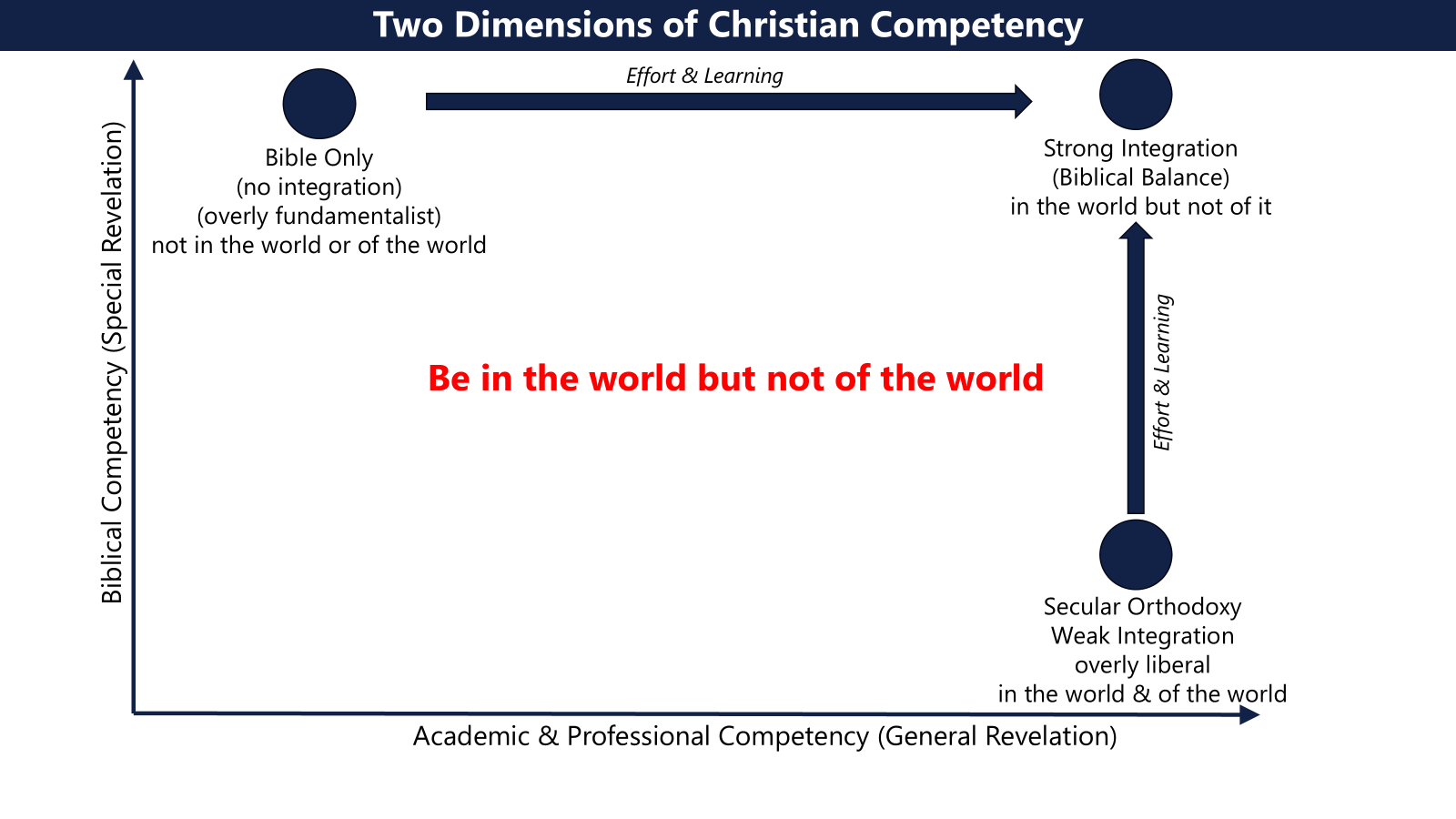
Christians are called to be “in the world but not of the world.” To do this we need to achieve both Biblical/Christian Competency (drawing on Special Revelation) and Academic & Professional Competency (drawing on General Revelation). Falling to either extreme on this spectrum compromises a ministry’s effectiveness. Organizations that prioritize professional skills while neglecting biblical grounding risk slipping into a “Secular Orthodoxy”; this represents a weak integration that is overly liberal and leaves the ministry firmly “in the world & of the world.” On the other hand, a “Bible Only” approach with no integration creates an overly fundamentalist environment where the mission is isolated, operating “not in the world or of the world.”
To reach the optimal state for the Fifth Wave Mission, organizations must apply deliberate effort and learning to move away from these isolated extremes. The goal is the upper-right quadrant of the chart, representing a “Strong Integration” and “Biblical Balance.” In this space, a ministry successfully merges high academic and professional competency with robust biblical revelation. By doing so, they fulfill the core directive highlighted at the center of the model: to “Be in the world but not of the world.” This dual pursuit ensures that missions are equipped to serve their communities with the highest professional standards without sacrificing their foundational Christian identity.
In The Past and Future of the Gospel Rescue Mission Movement I outline a framework and strategy of how to achieve this. If you would like to be a “beta reader” to provide feedback before publication, please respond in the comments below. One of the keys to improving our Christian competency as missions is to better understand the history of the larger Christian movement we are a part of. That will be the subject of the next article in this series.
You can listen to the podcast of this article here.
Powerful! Wow. We must stand against mission drift and stand for using the Gospel to rescue those in need...