
My last article was on “How Worldviews Shape Our Understanding of Causes & Solutions to Addiction.” This article explores a similar question, but focused on how our understanding of truth affects rescue mission program design. At the center of this question is the debate between the modern understanding of truth and the postmodern understanding of truth.
The modern view of truth was that, as humans, we can fully know objective truth. This is problematic biblically because as humans our understanding of truth is always limited and corrupted by the fall. The postmodern response to this was to go to the other extreme of relativism and declare that there is no objective truth. Over the past several decades Christian theologians, like N.T. Wright, have argued for a third alternative called Christian critical realism.
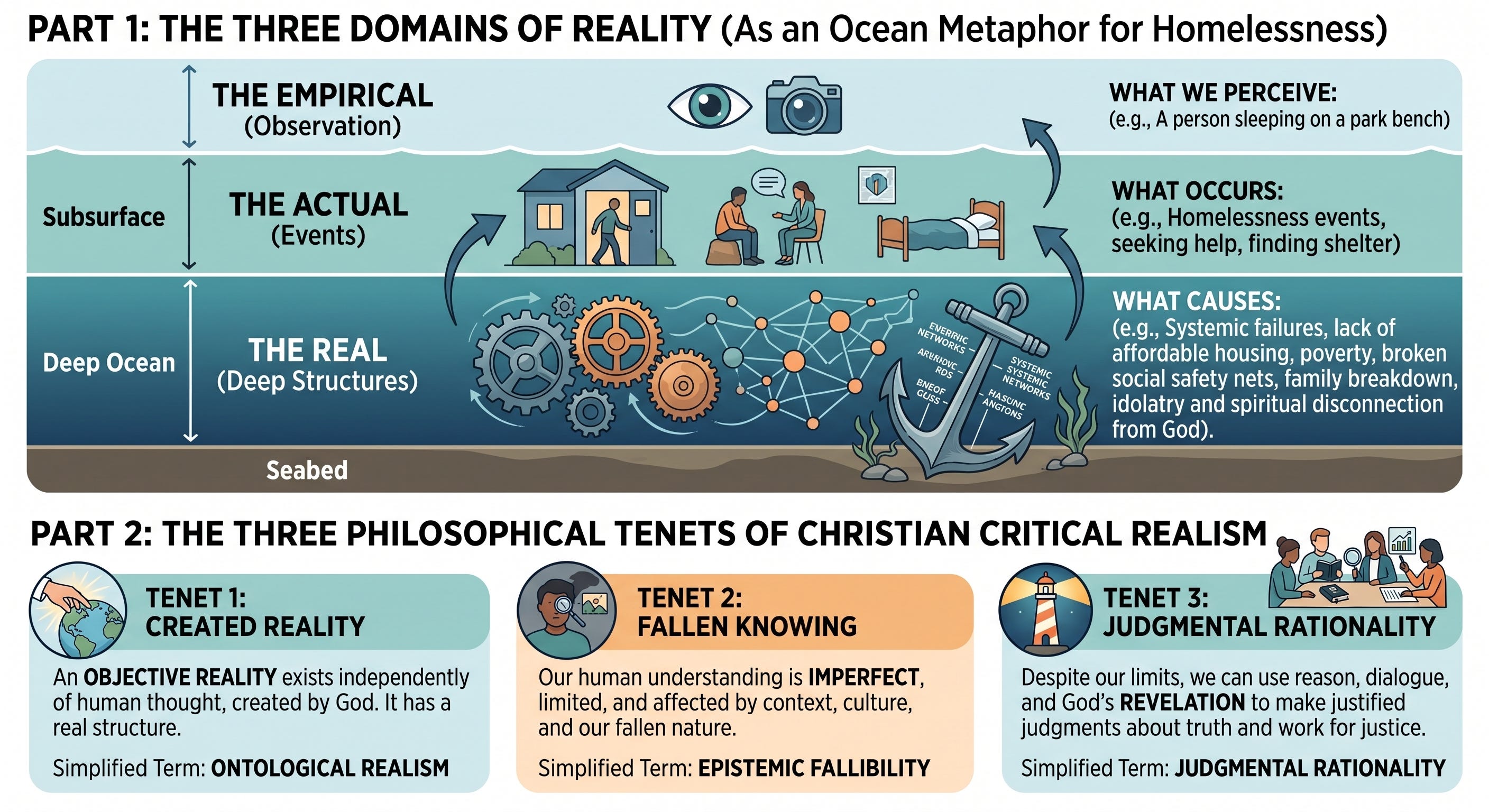
As shown in the diagram above, Christian critical realism is a framework that states there are three levels to reality:
The Empirical (Surface Level): This represents direct observation and what we perceive. For example, seeing a person sleeping on a park bench.
The Actual (Subsurface Level): This represents the events that occur, whether we see them or not. For example, the specific events of seeking help, finding shelter, or experiencing homelessness.
The Real (Deep Ocean / Seabed): This represents the deep, underlying structures and mechanisms that cause the events. For example, systemic failures, poverty, lack of affordable housing, idolatry, lack of spiritual connection to God and broken social safety nets.
It finds a middle ground between the pride of modernism and the relativism of postmodernism through three foundational beliefs:
Created Reality: An objective reality exists independently of human thought and possesses a real structure created by God. In philosophical terms, this is called Ontological Realism.
Fallen Knowing: Human understanding is inherently imperfect, limited, and shaped by context, culture, and human fallenness. In philosophical terms, this is called Epistemic Fallibility / Humility.
Judgmental Rationality: Despite human limitations, individuals can still use reason, dialogue, and God’s revelation to make justified judgments about what is true and to work toward justice.
Today, Christian Critical Realism is the primary framework for determining truth (epistemology) at most Bible-believing Christians universities. This framework enables Christian researchers to conduct their work to bridge their Biblical understanding with science.
Why Rescue Missions Follow Holistic Christian Critical Realism
In most research contexts, Christian Critical Realism follows what is called the “analytical method,” which breaks things into parts. This is because most science depends on the ability to change one variable at a time for research studies. The alternative to the analytical approach is a holistic approach, which looks at everything together rather than breaking it into parts. Essentially Christian Critical Realism has two approaches: the analytical and the holistic. I believe that how most Christians conduct ministry is through Holistic Christian Critical Realism. The most significant difference in Holistic Christian Critical Realism compared to Analytical Christian Critical Realism is in the approach and understanding of how God made us as people (called theological anthropology). This difference is shown in the diagram below.
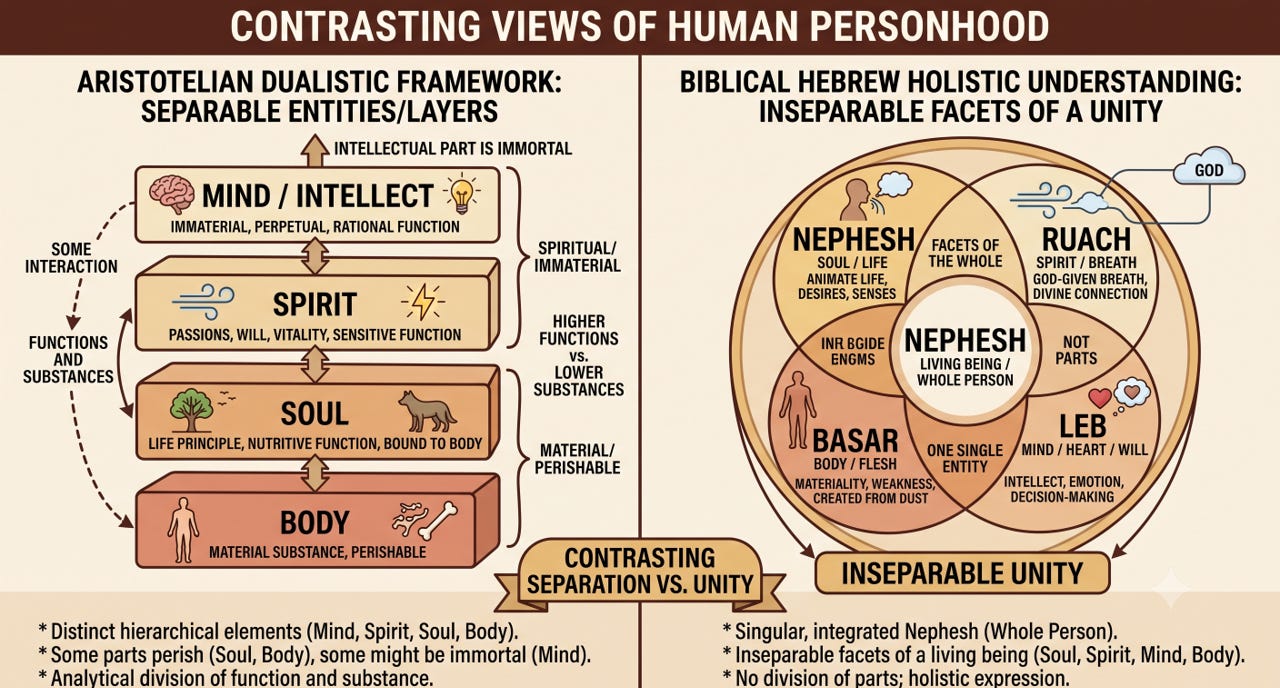
The Aristotelian model is analytical and divides the human into separable, hierarchical layers, ranging from a perishable, material "Body" at the base up through the "Soul" and "Spirit" to an immaterial, immortal "Mind/Intellect." Conversely, the Biblical Hebrew model represents the human as an inseparable, singular unity where overlapping facets—Basar (body/flesh), Leb (mind/heart/will), Ruach (spirit/breath), and Nephesh (soul/life)—interlock to form one whole living being. Unfortunately, many Bible-believing Christians still functionally follow the Aristotelian model, viewing human nature through fractured, distinct components rather than viewing it as a completely integrated, holistic expression of life.
How This Affects Rescue Mission Program Design
Secular models of addiction and homelessness often follow an analytical approach, breaking a person down into separate parts to be treated in isolation. For example, a secular program might provide a bed for the physical body, or prescribe therapy solely for the mind, treating these as completely separate issues to be fixed one by one. In contrast, Gospel Rescue Missions operate from a holistic Biblical understanding, viewing each person as an inseparable unity of body, mind, and spirit. Because these facets are interlocked, rescue missions design their programs to address physical needs, mental health, and spiritual growth all at the same time, recognizing that true healing cannot happen if you only treat a fragment of the person.
This holistic view also changes how rescue missions understand the root causes of homelessness and addiction, as illustrated by the ocean metaphor. While secular models might focus primarily on the surface level—what is easily observed, like someone sleeping on the street—or the immediate events of finding temporary shelter, rescue missions dive into the “deep ocean” of reality. They understand that the visible crisis is usually caused by deep, underlying structures such as trauma, broken family networks, poverty, and a profound lack of spiritual connection to God. Therefore, mission programs are designed not just to manage the surface-level symptoms, but to address the deep, hidden root causes that lead to a life on the streets.
Finally, the foundational beliefs of Holistic Christian Critical Realism give rescue missions a unique balance of humility and hope that secular programs often lack. Instead of relying solely on human science to perfectly fix everything, or giving up on absolute truth entirely, rescue missions recognize that while our world and our human understanding are broken, God’s objective truth and design still exist. This allows missions to use the best of human reason, evidence-based practices, and compassionate dialogue, while ultimately relying on God’s revelation and grace. By combining practical, holistic care with these deep spiritual truths, rescue missions offer a comprehensive path to true justice and lasting transformation rather than just a temporary fix.
Neurotheology of Addiction
So, why does all this matter? Holistic Christian Critical Realism provides a framework that enables rescue missions to engage more deeply with science to provide better evidence of why our programs work. In particular, there is an emerging field called the Neurotheology of Addiction that provides evidence from neuroscience on how the spiritual practices used by rescue missions rewire the brain. You can read more in the article The Neuroscience of Faith: How Rescue Missions Rewire the Addicted Brain.
Next Steps
If you find this useful, please share this article, videos or slides with staff at your ministry.
If you are interested in the ideas in this article, then you may be interested in the following City Vision courses starting on October 19:
ORG710: System Thinking, Worldviews and Social Change, also offered in a Master’s section
ADC701: Christian Approaches to Counseling and Life Transformation, also offered in Master’s & undergrad sections as ADC506 and ADC440.
Podcast and Slides
You can find the podcast for this article here. You can find slides below.
