
In my last article, I asked “Do Rescue Missions Need to be Concerned about Secularization?” I thought it might be helpful to follow that with an article on how worldviews shape our understanding of causes & solutions to addiction. When I refer to secularization, one way to characterize that is that secularization is when our Christian worldview gets assimilated into a secular worldview.
Both in developing City Vision’s doctoral program and in writing my upcoming book The Past and Future of the Rescue Mission Movement, I’ve been reflecting a lot on this question how worldviews shape our understanding of causes and solutions to addiction and homelessness. The basic idea is that while there is an absolute truth (God’s truth) of reality, we as observers always perceive that truth through our worldview and the particular theory we are using as shown in the diagram below.
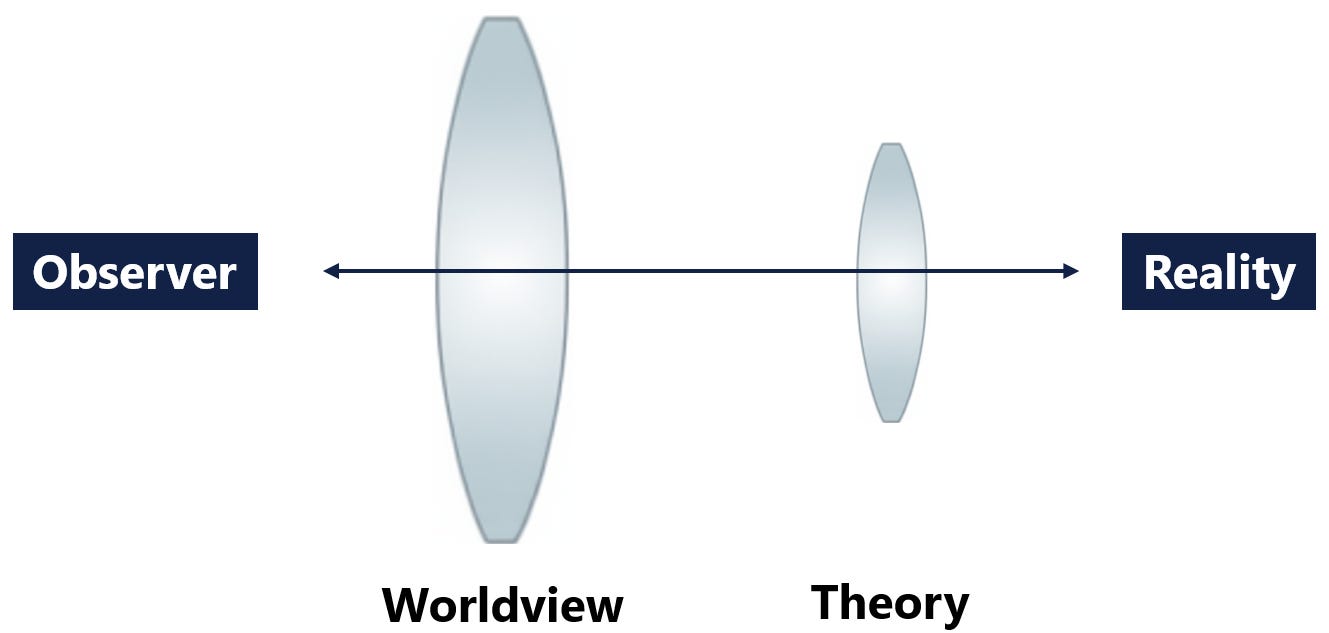
A key principle of this is that because of our flawed nature, we all “see through a glass, darkly.” - 1 Corinthians 13:12. As an experiment, I decided to develop Gemini Deep Research reports on causes and solutions to addition from two worldviews.
Worldview: secular scientific naturalism. Theory: Socio Ecological System Dynamics of Addiction
Worldview: holistic integrated Christian, Theory: Practical Christian Theology of Addiction
To make this more practical, I used some AI tools to develop both articles and videos on how each of these worldviews approaches the causes and solutions to addiction. Ultimately, my goal is to explain the need for strong Christian integration where we engage deeply with science but do so within a biblical Christian worldview.
Secular Scientific Worldview on Causes & Solutions to Addiction
Here is the research report I compiled on the secular scientific naturalism worldview on causes and solutions to addiction using the primary theoretical framework of the socio-ecological system dynamics of addiction. You can see a summary in the video above. A mathematical system dynamics model of this is below.
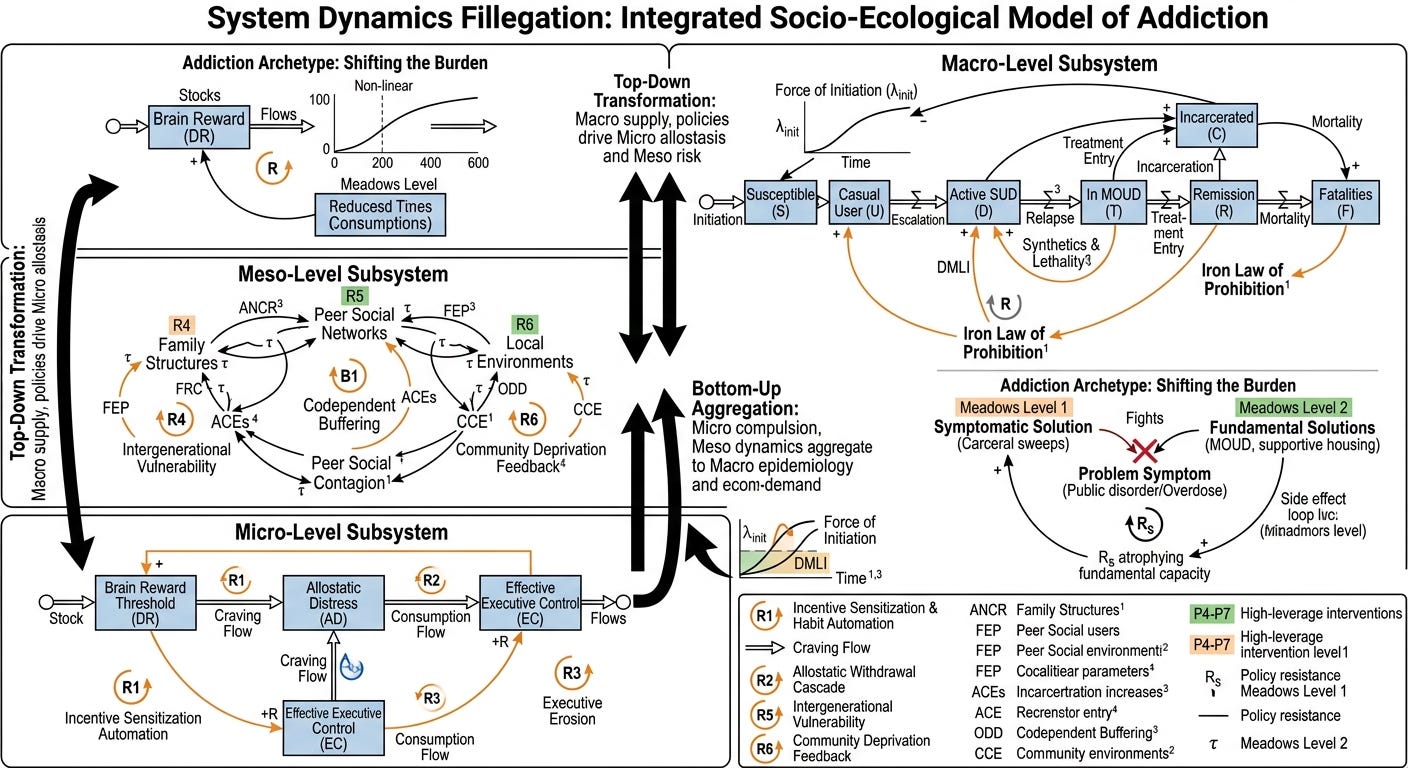
Within this worldview, breaking this cycle requires abandoning temporary, symptomatic fixes like arrests or forced unmedicated detox, which destroy community stability and fail to address the root systemic causes. Instead, effective recovery depends on matching the complexity of the addiction trap with comprehensive, multi-level solutions. This involves expanding life-saving harm reduction, removing administrative barriers to medical treatment, decriminalizing simple possession, and redirecting criminal justice funding toward long-term economic revitalization. For rescue mission staff, this underscores the necessity of pairing medical stabilization for the brain with strong, healthy community support and structural pathways to long-term housing and employment.
Not surprisingly, the secular scientific naturalism worldview recommends harm reduction as the primary strategy. A key point is that it is the naturalistic assumptions of the worldview that almost make that a forgone conclusion.
The Principle of Hume’s Guillotine & Why Science is Bad at Prescribing Solutions in Complex Systems
Hume’s Guillotine—first articulated by philosopher David Hume—establishes a strict boundary between descriptive facts (what “is”) and prescriptive moral imperatives (what “ought” to be), proving that ethical conclusions cannot be logically deduced solely from empirical observations. When applied to addiction, secular scientific naturalism and socio-ecological system dynamics excel at mapping the descriptive “is” because they analyze material reality without requiring metaphysical assumptions or subjective moralizing. This empirical framework provides an unmatched cartography of the mechanical feedback loops driving addiction across all levels: from micro-scale neurobiological processes like incentive sensitization, allostatic withdrawal cascades, and prefrontal executive erosion, to meso-scale dynamics like intergenerational trauma transmission and peer contagion, up to macro-scale structural forces such as community deprivation, economic despair, and the “Iron Law of Prohibition”. By treating the crisis as a vertically coupled system of differential equations and feedback structures, science rigorously explains how the physical and social machinery of addiction functions.
However, Hume’s Guillotine reveals that empirical data alone hits a logical wall when attempting to prescribe solutions, as biological measurements of dopamine depletion or overdose mortality cannot independently justify why human life ought to be preserved or what constitutes true human flourishing. Restricted by the naturalistic fallacy, secular public health models frequently derive their “ought” from survival metrics, defaulting to low-leverage symptomatic fixes—such as pharmacological stabilization and harm reduction—that manage systemic friction and chronic pathology without addressing the deeper drivers of human suffering. To bridge this is-ought gap and construct a meaningful prescriptive strategy, one must introduce normative, non-empirical premises regarding human nature and purpose, such as those provided by a holistic Christian worldview. By grounding human dignity in the imago Dei and framing recovery around an objective telos (final purpose), a worldview-driven approach moves beyond mere biological survival to intervene at the highest leverage points of system design—prescribing holistic regeneration, character formation, and the restoration of moral agency.
Christian Worldview on Causes & Solutions to Addiction
Here is the research report and a second report on Strong Christian Integration that I compiled on the a standard Christian worldview on causes and solutions to addiction using the primary theoretical framework of the socio-ecological system dynamics of addiction. You can see a summary in the video above.
While secular and theological models agree on the mechanics of addiction, they diverge sharply on the ultimate solution for human flourishing. Secular systems typically aim for stabilization and biological survival through harm reduction, whereas the Christian framework pursues holistic regeneration to restore human dignity and reconcile the individual with their creator. By offering long-term accountability, cognitive behavioral therapy paired with spiritual discipleship, and vocational training, holistic rescue missions seek to provide a sanctified community that breaks the cycle of toxic peer contagion and offers a compelling vision of a restored life.
How to Use This for Staff Training
You can use this YouTube playlist to teach your staff about how worldviews shape our understanding of causes & solutions to addiction & homelessness. If you only have time for one video, play the first video.
Questions for Discussion
Limitations of Empirical Naturalism. Naturalism is an assumption that limits the scientific worldview to focus on what can be explained by natural causes. Empiricism focuses only on what can be measured and experimentally validated. Explain reasons why the type of “solutions” provided recommended by empirical naturalism often are not as effective as those that incorporate a Christian worldview.
The Math of Creativity. Imagine that you are leading a creative arts program teaching future artist to create inspiring stories, movies, music and dance but you are told you can only teach students using math and neurobiology. Imagine that your instructor primary requires you to use a mathematical model called the “system dynamics of love stories” to write the script for a movie that is a love story. What are the problems with this type of approach to creativity and story telling? How does that relate to differences in approach between scientific empirical naturalism explaining solutions to addiction and Christian solutions?
Hume’s Guillotine. How do your answers to the above question relate to the principle of Hume’s Guillotine? Do you agree that the scientific worldview is often effective at describing what “is” regarding the dynamics of addiction?
Strong Christian Integration. Strong Christian integration attempts to extract the useful truth from science and integrate that with a Biblical Christian worldview. What are the key differences in perspective in a Christian worldview that often makes it more effective compared to those proposed by a secular worldview? What are key factors that determine whether you are able to perform strong Christian integration? If someone is a Christian and a licensed counselor, but they have had 10,000 hours of training primarily in a secular worldview, how much training in strong Christian Integration is likely needed to offset that? Is just being a strong Christian enough, or is specific training needed?
City Vision University Resources for Strong Christian Integration
For those who would like specific training in Strong Christian Integration, City Vision’s signature course on that is ADC701: Christian Approaches to Counseling and Life Transformation, also offered in Master’s & undergrad sections as ADC506 and ADC440. If you are interested in taking it, it will be offered in our Fall 2 Term - October 19 - December 13.
Podcast and Podcast Transcript
You can find the podcast for this article here or above. The transcript is below.
In this episode of the Rescue Mission podcast, we are focusing on explaining how worldviews shape our understanding of causes and solutions to addiction. Exactly. And it’s a topic that really gets to the heart of what’s happening out there. Yeah, I mean, consider this paradox for a second. Just down the street from where you work, there might be this massive, state-funded behavioral health clinic. Oh, absolutely. The ones with the $10 million annual budgets, right? Right. They’ve got the cutting-edge neuroblockers, highly credentialed psychiatrists, literally all the resources the state can muster. Yeah, but then what actually happens? Well, that’s the thing. The clients they treat are often just back on the street within a month. They get caught in the exact same devastating loops. It’s so frustrating to see. It really is.
And meanwhile, you’ve got your gospel rescue mission, right? Operating out of some old warehouse on a fraction of that budget. A tiny fraction, yeah. Yeah, and yet, you are seeing men and women completely rebuild their lives. You are seeing these holistic, permanent transformations that, honestly, they just defy the clinical statistics. They totally do. And it always brings up the question of why, you know? Exactly. Why does the well-funded machine fail so often to create lasting change, while the faith-based, shoestring operation routinely witnesses miracles? It’s the—it really is the defining mystery of modern addiction treatment. So today, we’re taking a deep dive into the invisible lenses we wear when we look at human suffering, and how those lenses dictate absolutely everything about how we try to heal it. Yeah, because it’s a conversation that’s going to fundamentally change how we understand brain chemistry, social policy, and really the architecture of the human soul. Definitely. The answer to that paradox you just laid out, it doesn’t lie in who has the better medication; it lies in worldviews.
Right. And before we go any further, I really want to offer a very warm, specific welcome to you. Yes, you, the dedicated staff at gospel rescue missions listening to this right now. You guys are the ones out there on the front lines every single day. You really are. You’re the folks doing the heavy lifting in the intake rooms, leading those morning chapel services, managing the chaos of the residential programs. Steering the sheer crisis of addiction right in the face. Yeah. So this deep dive is entirely custom-tailored for you. We’ve spent weeks, I mean literally weeks, synthesizing these deep clinical systems, dynamics models, theological reviews, and specifically this phenomenal research in the Rescue Mission Report by City Vision University. It’s incredible research. And we’re bringing all of this together because, well, you are navigating a massive, invisible collision of worldviews every time you walk into work. You really are, because reality is never encountered in this like raw, uninterpreted state. Yeah, never. You, me, your clients, the government policy makers, we are all wearing lenses. Always.
A worldview is essentially the overarching epistemological architecture that you use to filter reality. Okay, that’s a big phrase. Let’s— I know, I know. Think of it like the operating system on a computer. Oh, I like that. Right. It runs quietly in the background, but it dictates what software can run, how files are organized, and how the computer interacts with the outside world. Yeah. So if you’re working at a rescue mission, you’re constantly encountering clients and municipal policies that are operating on a completely different operating system than yours. Exactly. And if you don’t understand their operating system, you just won’t understand why their heavily funded programs are short-circuiting.
Okay, so let’s unpack this operating system idea. Before we can figure out how to solve addiction, we have to establish how we’re actually looking at it. Which brings us to a fundamental philosophical cornerstone in this research. Right. This concept called Hume’s Guillotine. Yes. Now, I want to keep the heavy academic jargon out of this, but it’s really crucial we understand this, right? The philosopher David Hume established that there is this strict, undeniable boundary between two things. Between what is and what ought to be. Yeah. It’s a brilliant distinction, really. When Hume talks about the “is,” he’s talking about descriptive, empirical facts. Like gravity pulls objects toward the Earth. Exactly. Or dopamine binds to specific receptors in the brain. The rent in this city is $2,000 a month. These are just measurable, undeniable facts of reality. Right. And science is an absolutely unparalleled tool for mapping the “is.” Oh, absolutely. It can measure and observe the mechanics of physical reality with a precision that would, frankly, look like magic to our ancestors. Totally.
But then, you know, you cross the boundary to the “ought.” The “ought” is the prescriptive moral imperative. It’s the ultimate goal, the destination, basically. Yeah. I like to think of it like diagnosing a severe compound fracture versus deciding what the patient’s life should look like after they finish physical therapy. That’s a great way to put it. Right. Because science is amazing at the “is.” It gives us the X-ray, it shows the exact millimeter of the bone fracture, it tracks the calcium depletion. It dictates the surgical intervention. Yeah. That is the empirical “is.” But science, by its very nature, it just cannot tell us what that patient ought to do with their healed arm. No, it can’t. Should they use that healed arm to build houses for the poor, or should they use it to punch their neighbor in the face? Right. Science has no mathematical equation to tell you what a human’s ultimate purpose is. Exactly. Science has no teleology. It has no framework for ultimate purpose or meaning. It maps the mechanics, but it cannot prescribe the morality.
So when we look at this secular, scientific worldview, which is often called scientific naturalism, right? Yeah. Scientific naturalism or empirical naturalism. We have to recognize its strict boundaries. Because this worldview operates on the fundamental premise that everything in existence can be fully explained by material reality: physics, biology, chemistry, social inputs. Basically, if it can’t be measured in a lab or tracked on a spreadsheet, it doesn’t exist. So it maps the mechanics of the human machine perfectly. It really does. But it has absolutely no framework for a human’s ultimate purpose. It has no category whatsoever for a soul. Wow.
And this is where Hume’s Guillotine drops. When secular naturalism tries to prescribe an “ought”—when it tries to design a solution for addiction—it’s basically forced to pull from an empty toolbox. Because it doesn’t recognize a soul. Exactly. Its “ought” can only aim for baseline biological survival, harm reduction, and symptom management. It tries to fix the broken parts of the machine, but it fundamentally doesn’t know what the machine was built for in the first place. Which is a huge problem.
See, I have to push back here for a second. Or at least, you know, play devil’s advocate. Sure, go for it. Because if I’m a secular social worker listening to this, I’m saying, “Hold on, our map of the ‘is’ is incredible.” And they wouldn’t be wrong. Right. They know exactly what addiction does to the brain, the family, and society. Yeah. If we have the perfect map of the broken bone, why isn’t that enough? Why isn’t a perfect, secular, biological intervention sufficient to fix a biological problem? Well, this raises an important question, and it’s exactly where we need to go next.
To truly understand why the secular “ought” fails, we actually have to validate just how brilliant their map of the “is” really is. We can’t just dismiss the science. We cannot dismiss the science. We have to look at the massive, multi-layered machine they have mapped out. And this brings us to what the research calls the Socio-Ecological System Dynamics Model. Yes. Which essentially takes the brilliant developmental psychology of Urie Bronfenbrenner and combines it with Jay Forrester’s Systems Dynamics. Right, which sounds complicated, but— Yeah, for you listening on the front lines, what this simply means is that addiction is not just one thing. It’s not just a bad choice, and it’s not just a genetic fluke. It is a highly complex, interlocking machine, and it operates on three distinct levels: the micro, the meso, and the macro.
So let’s break this down, starting at the absolute microscopic level: the human brain. Okay, so at the micro level, the secular model has identified three devastating reinforcing loops. And just a quick note: think of a reinforcing loop as a snowball rolling down a hill, right? Gathering mass and speed until it causes an avalanche. Exactly. And the first avalanche is Loop R1, which they call incentive sensitization. Okay, let’s translate that: incentive sensitization. What does that actually look like for the guy walking into a rescue mission today? It is the biological shift from goal-directed behavior to automated, compulsive habit. Automated. Meaning they aren’t really choosing it anymore. Right.
When someone first takes a highly addictive substance, let’s say meth or fentanyl, it triggers a massive, completely unnatural surge of dopamine. Okay. It travels from the ventral tegmental area to the nucleus accumbens. Now, we often colloquially refer to dopamine as the pleasure chemical. Right, everyone says that. But in neurobiology, that’s incredibly reductive. Dopamine is fundamentally about learning, motivation, and anticipation. It’s the brain’s highlighter pen, basically. It highlights behavior and says, “Hey, pay attention to this.” Yes, exactly. And when a drug floods the brain with a thousand times the normal amount of dopamine, it creates what neuroscientists call a reward prediction error. It basically hacks the evolutionary survival mechanism. The brain interprets this massive dopamine spike as the single most important survival activity the organism has ever encountered. Wow. It literally tells the brain, “This is more important than food, more important than water, more important than procreation. Do it again at all costs.”
So initially, in the early days of addiction, the person takes the drug because they like the subjective feeling of being high. Right. But through repeated exposure, the brain’s physical wiring actually begins to shift. Yes. The locus of behavioral control literally migrates in the brain. It moves. It does. It shifts from the ventral striatum, which handles conscious, goal-directed “I’m choosing to do this behavior”— Okay. —over to the dorsal striatum, which is the region responsible for deep, automated, involuntary habits. Let’s pause there because this is just mind-blowing. The subjective feeling of liking the drug literally decouples from the biological wanting of the drug. It completely decouples. I mean, I’ve heard counselors at rescue missions talk about this. They sit across from clients who say, “I hate this drug. I don’t even get high anymore. It ruins my life, but I cannot stop.” And the secular model proves that they aren’t lying. Their conscious mind hates it, but their dorsal striatum has completely automated the procurement and consumption of the substance. It’s like breathing or blinking. It just bypasses conscious choice. Exactly.
And just as that automation takes hold, the individual falls into Loop R2, which is the allostatic withdrawal cascade. The allostatic withdrawal cascade. Okay. Yeah. If R1 is the biological automation, R2 is what neurobiologists refer to as the dark side of addiction. Walk us through the dark side. What is happening physically to this person? Because the brain is constantly being assaulted by these unnatural dopamine floods, it attempts to protect itself and maintain homeostasis. It’s trying to survive the flood. Right. And it does this by down-regulating—essentially turning off or deleting—its own dopamine receptors. It turns the volume knob of pleasure all the way down. But it doesn’t stop there. The brain simultaneously recruits massive anti-reward stress circuits. It floods the entire central nervous system with stress hormones. Like cortisol. Specifically, corticotropin-releasing factor and dynorphin.
Okay, let me translate this for the intake worker listening right now. This means the person’s baseline level of normal human happiness completely evaporates. It’s all gone. They aren’t just missing the high; they enter this chronic, agonizing state of emotional dysphoria, extreme anxiety, and brutal physical withdrawal. Exactly. Their biological thermostat is totally broken. And this is vital for anyone in rescue mission work to deeply understand. Yeah. Eventually, the substance use has absolutely nothing to do with getting high. It transitions entirely to negative reinforcement. Meaning they’re just running from the pain. It becomes a frantic, desperate attempt to escape the sheer physical and emotional agony of the withdrawal state. The drug is the only thing that can temporarily relieve the acute distress.
But, and I’m guessing this is the reinforcing loop part, consuming the drug just makes it worse in the long run. Yes. Because consuming the drug further degrades the dopamine receptors and primes those stress circuits, meaning the next round of withdrawal will be exponentially worse. The loop tightens. The trap closes. Exactly. It is terrifying when you actually see the mechanics of it. And if the automation of R1 and the agony of R2 weren’t enough, the secular map gives us Loop R3: executive erosion. Yeah. Because chronic substance abuse is highly neurotoxic. It literally degrades the structural integrity of the prefrontal cortex. And the prefrontal cortex, that’s the decision-making center, right? Right. It’s the front part of the brain responsible for our highest cognitive functions: impulse control, emotional regulation, long-term planning, and weighing complex consequences.
I really want to focus on this because it directly impacts how rescue mission staff interact with clients. Oh, absolutely. The research mentions a term here: hyperbolic delay discounting. Now, that sounds like an economics term, but what does it mean for a human being in the throes of addiction? Hyperbolic delay discounting is basically the neurological inability to value a future reward over immediate relief. Okay, give me an example. Let’s say a well-meaning social worker sits down with a client and says, “Listen, if you stay sober for six months, you can get your job back. We can get you into supportive housing. You can slowly rebuild trust and reconcile with your children.” Those are massive, beautiful future rewards. They are. But because of the structural degradation of the prefrontal cortex, the client’s brain physically cannot compute that future value against the immediate, screaming, neurobiological demand of the dorsal striatum. It’s screaming to stop the current withdrawal pain. Exactly. The physical machinery required to make a good, long-term choice has literally been eroded away. It’s like asking someone with a broken leg to run a marathon and then getting frustrated when they can’t do it. That is a perfect analogy.
The biological hardware for long-term decision-making is severely compromised. So that is the micro level. That is the internal trap inside the skull. But this Socio-Ecological Systems Model shows us that this brain doesn’t exist in a vacuum. It is constantly interacting with the meso level: the immediate relationships, the family, the community. Which brings us to the social feedback loops. Loop R4 is intergenerational vulnerability. And if you work at a rescue mission, you know this story intimately. You do an intake interview, and you realize the addiction didn’t start with the 25-year-old sitting in front of you. No, it started two generations ago. Right.
We’re talking about adverse childhood experiences: trauma, neglect, household instability, seeing violence in the home. And the secular science shows us that this isn’t just psychological trauma; it is physiological. A child growing up in a chaotic, substance-abusing household experiences chronic, toxic stress. It literally changes their body. Yes. It physically primes their HPA axis—the hypothalamic-pituitary-adrenal axis, which controls the body’s stress response. So they enter adolescence with a heightened, hyper-reactive baseline of stress. And a diminished capacity for emotional regulation. They are biologically pre-vulnerable before they ever take their first drink or drug. The system is just primed for addiction.
And once that addiction takes hold in the family unit, we see the emergence of Loop B1: enabling. Yes, the enabling loop. And I really want to dive into this because the systems dynamics terminology used here is fascinating. They call enabling a “balancing turned eroding loop.” What does that mean? Well, think about the natural instinct of a mother, a father, or a spouse when someone they love is spiraling into the abyss of addiction. They want to save them. They want to fix it. Their immediate, desperate desire is to maintain stability. They want to protect their loved one from harm. So, they engage in enabling behaviors. They pay the overdue rent. They call the employer and lie about why their son isn’t at work. They drain their savings to bail them out of jail. Now, in the short term, this is a balancing loop. Right, it stabilizes the immediate crisis. Exactly. Keeps a roof over their head for one more month. But over time, it turns into an eroding loop. Precisely. Because while it temporarily stabilizes the household today, it accidentally prolongs the addiction indefinitely. By buffering them from the consequences. It buffers the individual from the natural, painful consequences of their actions. Often, it is only the sheer pain of those consequences—hitting rock bottom, facing eviction, sitting in a jail cell—that can finally pierce through that hyperbolic delay discounting we talked about. The pain is the only thing loud enough to break through the broken prefrontal cortex. Right. To force the individual to accept treatment. Enabling shields them from reality, allowing the internal biological loops of R1 and R2 to dig deeper and deeper without interruption. Wow.
And as the family exhausts their resources, or finally sets boundaries, the individual falls into Loop R5: peer contagion. Yeah, because as the addiction becomes more severe, more chaotic, and more demanding, it creates intense social friction. So non-using friends slowly pull away. Or the individual intentionally alienates them out of shame or paranoia. Right. Furthermore, the sheer logistical, everyday demand of procuring illegal drugs naturally draws the person into closer proximity with active drug users and dealers. You get a phenomenon known as homophilic clustering. Homophilic clustering. Meaning birds of a feather flock together, basically. Yes. But in this case, it’s driven by the intense demands of the addiction economy. People with severe, active addictions are structurally pushed into highly concentrated, insular networks of other people with severe, active addictions. And within these closed networks, extreme, life-threatening substance use is just completely normalized. It becomes the social baseline. The cultural norms of this micro-community actively discourage sobriety and reinforce the addiction.
Okay, so we’ve mapped the internal breakdown of the brain, and the breakdown of the family and peer group. But these groups of people are walking the streets of a larger city. Right. They are operating within overarching societal structures, which brings us to the macro level of the secular “is.” And this is where the map gets incredibly bleak. Loop R7 is structural despair. We really cannot ignore the macroeconomic shifts that act as an accelerant to the addiction crisis. What kind of shifts? Over the past few decades, we have seen massive deindustrialization, wage stagnation in the working class, and the loss of meaningful, dignified, blue-collar employment in many communities. Right. And when a community loses its economic engine, it doesn’t just lose money. Oh, it loses a lot more. It loses access to the natural human rewards that keep us grounded: the pride of a hard day’s physical work, the realistic hope of homeownership, the ability to provide for a family, Upward mobility. —the dignity of being needed by your community. All of that is gone.
And when you strip a community of those natural, structural sources of dopamine and purpose, you leave a gaping void. So the drugs fill the void. In the absence of a meaningful future, the subjective, immediate value of chemically altering your consciousness skyrockets. If reality offers no hope, a synthetic escape becomes highly rationalized.
Which leads us to the most devastating macro loop of all: Loop R8. This combines carceral exclusion with something called the Iron Law of Prohibition. This is a big one. I want to spend some time here, because this is one of the most eye-opening explanations for why the modern drug supply has become a literal weapon of mass destruction. The Iron Law of Prohibition is this fascinating, brutal economic paradox. Walk us through it. The Iron Law of Prohibition dictates that the harder law enforcement cracks down on a prohibited substance, the more potent and lethal that substance will become. How does that work? Let’s look at the economics of a drug cartel. Their supply lines are constantly under attack by border patrol, the DEA, and local police. If a transit route becomes highly risky, the cartel doesn’t just give up and go out of business. Right, they are ruthless capitalists. They adapt. They have to maximize their profit per unit of volume. Because moving a massive shipping container is too risky, they need something smaller.
Exactly. So they stop cultivating and smuggling bulky, low-potency agricultural products like raw opium, heroin, or large bales of marijuana. And instead, they shift their entire business model to highly concentrated synthetic chemicals. They shift to fentanyl. Because fentanyl is entirely decoupled from agricultural crop cycles. You don’t need a poppy field in the mountains. No, you just need a small, clandestine lab and precursor chemicals. It is incredibly compact, easy to hide in small compartments, and it is exponentially more potent than heroin. A briefcase of fentanyl is worth millions of dollars and can supply a whole city. Exactly. Whereas you’d need a semi-truck of heroin for the exact same economic yield.
But here is the catastrophic fallout. Because fentanyl is synthesized in clandestine labs and cut in unregulated environments, it introduces massive dosing variance on the street. Right. A user buying a pill thinks they are managing their withdrawal—managing Loop R2—but the pill contains a fatal dose. This economic law of prohibition is exactly why we are seeing unprecedented, historic spikes in overdose mortalities. The supply has literally been poisoned by the economics of smuggling. It’s tragic.
And when an individual is caught in this lethal market, they inevitably collide with the justice system. This is the carceral exclusion part of the loop. Right, they get arrested and thrown in jail. Now, some people might think, “Well, at least they are off the streets and can get clean.” But the systems dynamics model shows this is often a fatal trap. Really? Yes. Incarceration severs whatever fragile ties the individual had left to legal employment or stable housing. And crucially, they acquire a criminal record. Which follows them forever. When they are eventually released, that record acts as a permanent legal barrier. It blocks them from federally subsidized housing, it disqualifies them from most dignified employment, and it plunges them deeper into structural despair.
And the biological kicker here is horrifying. While they were in jail, they involuntarily lost their physical tolerance to the drug. Right. So they are released back into the exact same environment of structural despair, with no job, no housing, and deep trauma. The psychological drive to use is massive, but their biological tolerance is zero. They take their normal dose, which is now laced with fentanyl, and their risk of a fatal overdose in those first few weeks post-release is astronomically high.
So step back and look at the secular map here. We have this beautifully detailed, mathematically precise, scientifically rigorous map of the secular “is.” We see the neurobiological erosion, the family trauma, the economic decay, the carceral trapping, and the lethal market forces all interlocking into a giant, suffocating machine. It’s incredibly thorough.
Okay, here’s where it gets really interesting, and this is the core friction of this entire deep dive. We have mapped out this incredibly complex biological and social machine. The secular scientists know exactly how this machine works. They have MRI scans, sociological data, and economic models. Everything you could possibly measure. Right. So if secular science is so incredibly smart and they know exactly how this machine works, why do secular policy interventions often result in what the research calls “policy resistance” or “better-before-worse” outcomes? That is the $10 million question. Why do they spend billions of dollars armed with this perfect map and still fail to actually fix the people caught in the trap?
If we connect this to the bigger picture, we have to go back to Hume’s Guillotine. Right. The secular worldview only recognizes material reality. Therefore, it attempts to fix a material machine by tweaking numerical parameters. Just moving numbers around? Secular policy says, “The machine is broken, let’s adjust the inputs.” They say, “Let’s subsidize 10,000 more doses of naloxone to reverse overdoses.” Or, “Let’s adjust sentencing guidelines to reduce the carceral loop.” Or, “Let me increase the number of temporary, low-barrier shelter beds in the city.” Which, I mean, those all sound like deeply logical, material responses to a material diagnosis. They are. But they are entirely symptomatic fixes. They manage the biological decay, they keep the person breathing for one more day, which is good, but they fundamentally ignore the spiritual engine that drives the human will. Wow. They treat the human being like a complex biological clock that just needs its gears oiled, rather than a spiritual being that needs a new heart. They change the environment around the person, but they have no mechanism to change the person from the inside out. Exactly.
And this, right here, is exactly why the gospel rescue mission approach is so radically different. Having spent all this time mapping the scientific “is,” we now need to pivot. We need to look at how the Christian worldview looks at the exact same data. Right. The exact same fMRI scans, the exact same feedback loops, but translates it into a radically different “ought.” We are moving into section three of our deep dive: translating mechanics into theology.
Let’s start right back at the micro level: the brain. Okay. The secular model looks at the down-regulated dopamine receptors and the degraded prefrontal cortex. Because it has no concept of a soul, it slaps a label on this: a chronic, relapsing brain disease. It categorizes addiction purely as an involuntary pathology. But the Christian worldview, utilizing robust biblical counseling concepts like those from Edward T. Welch, looks at the exact same brain scan and redefines this biological reality as the physical manifestation of idolatry. Edward Welch calls it a worship disorder. He describes addiction as “a banquet in the grave.” It’s a powerful phrase.
Now, I want to play the skeptic here again, because this is where a secular social worker would just, you know, throw their hands up in the air. I can hear them now. They would say, “Wait a minute. You just spent 20 minutes explaining how the drug literally hijacks the survival center of the brain and erodes their impulse control. Their brain is physically broken. How is it fair, or even compassionate, for the Christian worldview to call that a worship disorder or idolatry? Doesn’t that just sound like cruel victim-blaming? Aren’t you just slapping a harsh religious label on a sick person?”
That is the most common pushback, and it fundamentally misunderstands what the Christian worldview is saying. How so? To understand this, we have to realize that human beings are psychosomatic unities. We are both body and soul, inextricably linked. Okay. The Christian worldview doesn’t deny the physical brokenness. It says the physical brokenness is the trailing indicator of a spiritual reality. Humans were inherently, beautifully designed by God to worship the Creator. We are built to find our ultimate meaning, comfort, and satisfaction in Him. But in addiction, the human heart takes a created substance, a chemical, and elevates it to the position of ultimate significance. It basically makes a false god out of a molecule. Exactly.
And the biological changes we talked about—the shift from conscious liking to automated wanting, the desperate, agonizing escape from withdrawal—that is exactly what idolatry looks like on a brain scan. It’s physical. It is the physical, neurological reality of being enslaved to a false god that demands everything you have—your family, your job, your health—and gives you absolutely nothing but death in return. Wow. So the brain scan is basically a photograph of spiritual bondage. Yes! And what is fascinating is that this is not some new, modern psychological concept. Right. Long before we had functional MRI machines to map the dorsal striatum and dopamine pathways, Saint Augustine accurately described this exact biological automation in his famous work, Confessions.
Oh, that’s right. He mapped what we now call the iron chain of the will. He did. I love this quote. Augustine wrote: “From a perverse will proceeded lust; serving this lust produced habit; and habit not resisted became necessity.” It is brilliant. Augustine perfectly described Loops R1 and R2 centuries ago. He didn’t need an MRI. Exactly. He understood that human choices are not made in a vacuum. Repeated choices carve grooves into our very nature.
And to build on Augustine, the research brings in the towering intellect of Thomas Aquinas, specifically his concept of habitus. Let me translate habitus for our rescue mission staff. What does Aquinas mean by that? Aquinas argued that human actions, when repeated over time, forge deep, enduring dispositions in our nature. They become a habitus, which translates to a second nature. A second nature. Yes. This second nature actively shapes our character and severely constrains our future choices. It becomes deeply ingrained, almost automatic.
So what does this all mean for the front-line rescue mission worker sitting in an intake room? Well, it means you have a radically different understanding of the person sitting across from you. Right. You aren’t just looking at a helpless victim of a purely involuntary brain disease who has absolutely no agency. But you also aren’t looking at someone who is making completely free, rational, unhindered choices and just needs to, you know, try harder. Yeah. “Just say no”—it’s not that simple. It is a profound synthesis. It is a choice, an initial turning of the will away from God and toward a substance that, through repetition and sin, creates a physiological second nature that literally enslaves the physical will.
So the executive erosion we talked about in Loop R3 is entirely real. Their biological machinery for willpower is genuinely depleted. But the Christian understands that it is a depletion born of a spiritual disorder. The will is bound by the consequences of its own idolatry. This changes everything about how you counsel someone. You can offer immense grace because you recognize the sheer, terrifying power of the biological chain they are in. Exactly. But you also maintain accountability because you recognize they are a spiritual being with a will that needs to be called to repentance.
And this theological translation doesn’t stop at the brain. It applies to the meso and macro levels as well. How does that look socially? Well, when the secular model identifies peer contagion and homophilic clustering—the way addicts group together and normalize the behavior—the Christian worldview looks at that and recognizes it as a counterfeit community. A dark parody of what we were meant for. Yes. We were built for deep, covenantal fellowship, for church, for bearing one another’s burdens. Addiction twists that desire for belonging and traps people in a community bonded only by mutual destruction and the shared trauma of procuring the substance. It’s tragic.
And at the macro level, the translation is even more profound. Let’s talk about the macro level, because that’s the cartels and the laws. Right. When we look at the Iron Law of Prohibition, the ruthless, murderous economic exploitation by the cartels, the flooding of streets with synthetic poison, and the dehumanizing grind of the carceral system, the Christian worldview sees something much deeper, much darker than just bad public policy. The research references the theologian Walter Wink here. And what did Wink say? Wink viewed these massive, systemic, crushing institutional forces as the manifestation of fallen principalities and powers.
Wait, walk me through that. Because if I’m a clinically trained social worker, my immediate reaction to hearing “principalities and powers” is that we are abandoning sociology for spooky theology. I get that, but it’s not spooky at all. It’s a robust theology of systemic evil. Okay. Wink argued that institutions, economic structures, and legal systems have an inner spiritual reality. When an economic system like a drug cartel operates on pure, ruthless greed, treating human lives as disposable commodities for profit, that is not just an economic phenomenon. It’s something worse. That is demonic. It is spiritual warfare playing out through institutional structures. The Christian worldview recognizes that you aren’t just fighting a chemical compound; you are fighting entrenched spiritual forces of darkness that animate the macro structures of society.
This all culminates in the most massive divergence between the two worldviews. It all comes down to identity: Who is this person? The secular model, because it is trapped in materialist disease management, labels the person as an “addict in perpetual recovery.” Because the brain is structurally altered, they are a chronic patient. Their biology must be managed by the state indefinitely. “Hi, my name is John, I’m an addict, and I’ll always be an addict.” That is the secular identity. It defines the person entirely by their pathology.
But the Christian worldview sees something entirely different. It looks past the track marks, past the degraded prefrontal cortex, past the rap sheet, and it sees a desperately broken, but infinitely valuable, immortal soul. It sees a redeemed Imago Dei—an image of God. The Christian lens insists that this person is capable of being completely regenerated. They are not destined to be a lifelong patient of the state. They are capable of inhabiting true virtue, holiness, and divine sonship. That’s a completely different destination. The secular goal is merely to stop the person from dying. The Christian goal is to resurrect the human being. That is just incredibly powerful.
So we have these two vastly different maps of reality: the secular machine and the Christian theology of redemption. Yeah. How do these differing worldviews actually change how we treat people on a Tuesday afternoon at the rescue mission? To understand how this works in practice, the research introduces a brilliant framework from systems theorist Donella Meadows. Donella Meadows was a pioneer in systems thinking. She created a framework for leverage points. Leverage points. What does that mean in this context? Well, if you want to change a massive, highly complex system like the interlocking addiction crisis gripping your city, where do you push? Where is the leverage that actually changes the behavior of the system? And she categorizes leverage points from low to high, right? Number 12 down to 1. And this perfectly illustrates the limits of the secular approach.
Exactly. Low-leverage interventions are things like tweaking numbers and physical parameters within an existing system. So what’s that in the secular domain? In the secular domain, this is level 12 through 10. Practically, this looks like adjusting the count of temporary shelter beds, handing out clean syringes, subsidizing millions of doses of Narcan, or changing sentencing laws to shorten jail times. Then you move slightly up to medium leverage, which is levels 9 through 6. This involves modifying information flows and feedback loops. Yeah, this is where secular interventions utilize drug-checking data so users know if fentanyl is in their supply, or providing medication-assisted treatment like methadone or buprenorphine to buffer the biological withdrawal loop.
Now, I want to be incredibly clear here, and the sources emphasize this: the Christian worldview does not say these low and medium leverage interventions are evil. Absolutely not. Right. Harm reduction keeps people breathing. A dead person cannot hear the gospel. A bed keeps someone from freezing to death. Narcan is a miracle drug that reverses a fatal overdose. We thank God for these things. We absolutely do. They are highly effective for biological survival. But according to Meadows’ systems dynamics, they are low and medium leverage because they do not change the fundamental nature of the system. They just slow down the snowball. They merely manage the decay. They do not cure the underlying condition of the soul. If you only operate at levels 12 through 6, you will have a very busy, very well-funded clinic, but you will not have transformation.
To effect real, systemic change, Meadows says you have to move to high-leverage interventions, which are levels 3 and 2. Let’s look at level 3. Level 3 is changing the goals of the system. Okay, think about the goal of a secular, state-funded harm reduction clinic. The goal is minimizing friction on society: keep the person alive, reduce the spread of bloodborne diseases, and keep them out of public parks so the taxpayer doesn’t complain. But the Christian goal of the system—the goal of a gospel rescue mission—is radically different. The goal is whole-person recovery.
Whole-person recovery. What does that actually encompass? It is holistic regeneration. It is deep spiritual discipleship. It is restoring vocational dignity by teaching them to work again. It is reconciling them with their alienated families. Yeah. And ultimately, it is total reconciliation with God. Now, think about how that changes your daily operations. It changes everything. If your goal changes from “keep them alive and out of the park” to “help them become a flourishing, virtuous reflection of Jesus Christ,” your entire programmatic structure must change. You can’t just hand them a sandwich in a tent; you have to walk with them through the valley of the shadow of death.
Which naturally leads to level 2 leverage: changing the paradigm out of which the system arises. We discussed this deeply when we talked about identity. This is the massive systemic shift from viewing the individual as a broken biological machine that needs parameter adjustments, to viewing them as a redeemable soul capable of bearing the image of God. When the paradigm shifts, the treatment shifts from mere medical management to deep, relational discipleship.
But here is the absolute pinnacle of the research: the ultimate leverage point in any system. Level 1. Yeah, this is it. I got chills reading this part of the material. Level 1 is the power to transcend paradigms. What’s fascinating here is Level 1: transcending the paradigm altogether. The secular, materialist paradigm is closed. It strictly believes nothing exists outside of the physical system. The physical universe is all there is, was, or ever will be. Therefore, the only tools available are physical tools.
But the Christian model recognizes the terrifying truth: human engineering, no matter how brilliant, no matter how well-funded, cannot fix human idolatry. You cannot medicate away a worship disorder. You cannot give someone a housing voucher and expect their sinful nature to evaporate. Exactly. So the Christian worldview relies on an external, transcendent variable. It relies on a power that comes from completely outside the closed system of physics and biology. It relies on the supernatural, regenerating power of the Holy Spirit.
Boom. That is it. That is the fundamental difference that answers the mystery we set up at the very beginning of this deep dive. Why does the warehouse mission succeed where the billion-dollar clinic fails? Because the Christian model introduces a transcendent power into a closed biological loop. You cannot break the iron chain of the will, forged by years of biological automation and spiritual rebellion, with just cognitive behavioral therapy. Oh, no, no, no. You need a force capable of reaching into the human chest, removing the heart of stone, and replacing it with a heart of flesh. You need a force that changes the fundamental, underlying desires of the human soul. The Holy Spirit disrupts the entire socio-ecological machine at its absolute core.
So, we have laid out some incredibly deep philosophical, biological, and theological frameworks today. The question for you, the front-line rescue mission worker, is: How do we take all of this and apply it on the ground? Right. How do you combine the undeniable realities of the scientific map with the transcendent power of the Christian worldview? This brings us to the ultimate synthesis, what the Rescue Mission Report calls the Strong Christian Integration Model. And I want to be really clear about what this is, because it’s easy to misunderstand.
Yes, Strong Christian Integration is not about rejecting science. We do not look at the fMRI scans, the dopamine down-regulation, or the generational trauma and say, “That’s just secular nonsense, throw it away, all we need is a Bible and a prayer.” No. To do that would be theological malpractice and deeply unloving to the person suffering. Exactly. Strong Christian Integration means we absolutely, rigorously utilize the clinical mapping of the “is.” We train our staff in trauma-informed care. We deeply understand the dynamics of the allostatic withdrawal cascade so we can medically support a client going through detox. We study the socio-ecological factors of homelessness. We use the absolute best science available.
But—and this is the crucial pivot—we completely subordinate all of that clinical data to the biblical “ought.” The science serves the theology. The neurobiology is used as a tool to help achieve the ultimate goal of restoring the Imago Dei.
A perfect real-world example of this provided in the text is the San Diego Rescue Mission’s Mission Academy. Yeah, they don’t just offer temporary shelter beds, right? Right. They understand the severity of those biological and social loops. They know that handing someone a sandwich and sending them back to the homophilic clustering of the streets is a death sentence. So, they offer a highly structured, immersive, 12-month residential program. Walk us through what that 12-month immersion actually looks like, and why it is scientifically and theologically sound.
They are blending evidence-based practices like cognitive behavioral therapy and robust vocational training with daily biblical discipleship and intense spiritual counseling. And they demand a high-accountability environment. Why? Because scientifically, they know they have to disrupt Loop R5, the peer contagion. They have to physically remove the person from the counterfeit community of the streets and replace it with a sanctified, covenantal community. They are addressing the brain chemistry, the executive erosion, through highly structured routine, demanding accountability, and skill-building. And they are simultaneously addressing the worship disorder, the idolatry, through the gospel of Jesus Christ. They are using the science to stabilize the brain so the soul can hear the gospel. Exactly.
But this highlights a massive operational challenge for rescue mission leadership. What’s the challenge? Well, why is staff training so absolutely critical here? If you are an executive director or a program manager at a rescue mission, you have to understand the background of the people you are hiring. Right. Your clinically trained staff, your licensed clinical social workers, your behavioral health counselors, your case managers... They have likely received thousands of hours of university instruction steeped entirely in the secular worldview of empirical naturalism. They were trained by the secular system, using the secular map, to achieve secular goals. Yes.
And to explain the inherent friction this causes, the Rescue Mission Report provides a brilliant analogy. I’ll let you explain it, because it perfectly captures the dilemma. It’s the “Math of Creativity” analogy. Imagine you were trying to teach a student how to write a beautiful, inspiring, heart-wrenching love story. You want them to write the next great romantic novel. Okay. But you give them a strict rule: they are only allowed to use the languages of calculus, geometry, and neurobiology. How would they even begin? They can’t! They might be able to calculate the exact heart rate of the lovers when they kiss. They might be able to map the dopamine surge in their brains. They could calculate the geometry of the room they are standing in. But they absolutely cannot capture the invisible essence of love, sacrifice, and devotion using only equations and dopamine metrics. It is the wrong language for the ultimate goal.
And that is exactly what it is like trying to cure a human soul using only secular biology. The secular behavioral health industry is forcing your counselors to write a story of spiritual redemption using only the language of neurobiology and social work. You are using the wrong language for the ultimate goal. Therefore, it is not enough for a rescue mission to just hire Christians. Yeah. You can hire a devout Christian social worker, but if they were only trained in secular methodology, they will default to that methodology under pressure. You have to actively, intentionally train your teams in Strong Christian Integration. You have to teach them the limitations of the secular lenses they were taught to wear in their university master’s programs. Because if you don’t continually train them in worldview integration, the daily grind—the sheer, overwhelming volume of trauma and crisis they face every day—will force them to default to secular symptomatic fixes. Why? Because that is the default language of the behavioral health industry. It’s easier to just manage the symptoms than to engage in the exhausting, beautiful, messy work of spiritual discipleship.
You have to equip your teams to navigate these worldviews intentionally. You have to give them the language to see the neurobiology and the theology working together. And to help you do exactly that, we have some highly actionable advice for you today. We strongly encourage you—the leadership and staff listening right now—to take the Rescue Mission Report article and the associated YouTube playlist videos that were highlighted in the research, and use them directly in your next staff training module.
Specifically, the report provides four excellent questions for discussion. These questions cover:
The limitations of empirical naturalism
The “Math of Creativity” analogy
The implications of Hume’s Guillotine for daily operations
The practical application of Strong Christian Integration on the mission floor
Don’t just read them; use those questions to spark real, deep, challenging dialogue among your intake teams, your chaplains, and your program directors. Get them talking about the invisible lenses they are wearing when a client walks through the door.
And for those who would like specific, deep-dive training in Strong Christian Integration, City Vision’s signature course on that is ADC 701: Christian Approaches to Counseling and Life Transformation. It is also offered in master’s and undergrad sections as ADC 506 and ADC 440. If you are interested in taking it and equipping your team with this exact framework, it will be offered in our fall 2-term (October 19 to December 13).
Before we close this deep dive, I want to leave you with one final, provocative thought. Think about the intense pressure your rescue missions face every single year from secular funders, municipal governments, and grant writers. The pressure is always to become more scientific—which, in their language, usually means dropping the spiritual requirements, lowering behavioral expectations, and adopting unconditional Housing First models. “Just give them the key and leave them alone.” That’s the secular pressure. Exactly.
But consider this: What if the very things that make your rescue mission appear “unscientific” to the secular world—things like mandatory morning chapel services, highly demanding behavioral accountability, deep spiritual discipleship, and requiring individuals to sever ties with their old networks—what if those exact practices are actually, according to the most advanced systems dynamics models of leverage points, the absolute most scientifically sound, high-leverage interventions possible for breaking complex biological loops? What if treating the soul is actually the most scientifically effective way to heal the brain?
Thank you all so much for the incredible, unseen, life-saving work you do in the trenches every single day. Keep fighting the good fight, keep pressing into this research, and we will see you on the next deep dive.